
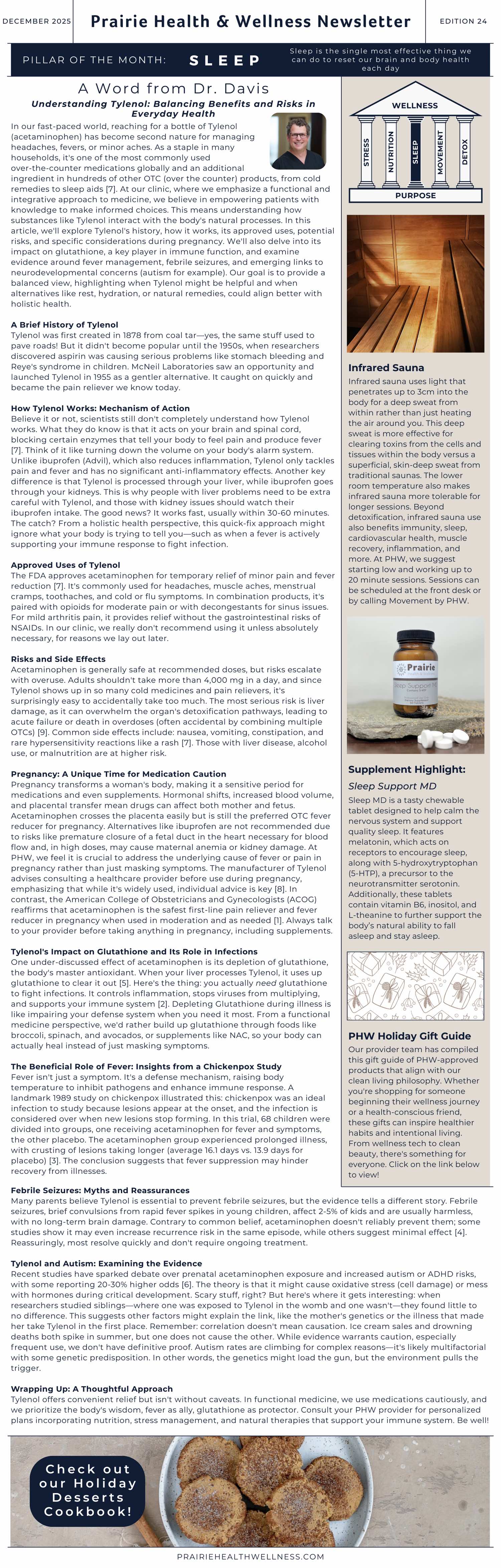
Prairie Health & Wellness Newsletter — December 2025, Edition 24
Pillar of the Month: Sleep
Sleep is the single most effective thing we can do to reset our brain and body health each day
A Word from Dr. Davis
Understanding Tylenol: Balancing Benefits and Risks in Everyday Health
In our fast-paced world, reaching for a bottle of Tylenol (acetaminophen) has become second nature for managing headaches, fevers, or minor aches. As a staple in many households, it’s one of the most commonly used over-the-counter medications globally and an additional ingredient in hundreds of other OTC (over the counter) products, from cold remedies to sleep aids [7]. At our clinic, where we emphasize a functional and integrative approach to medicine, we believe in empowering patients with knowledge to make informed choices. This means understanding how substances like Tylenol interact with the body’s natural processes. In this article, we’ll explore Tylenol’s history, how it works, its approved uses, potential risks, and specific considerations during pregnancy. We’ll also delve into its impact on glutathione, a key player in immune function, and examine evidence around fever management, febrile seizures, and emerging links to neurodevelopmental concerns (autism for example). Our goal is to provide a balanced view, highlighting when Tylenol might be helpful and when alternatives like rest, hydration, or natural remedies, could align better with holistic health.
A Brief History of Tylenol
Tylenol was first created in 1878 from coal tar—yes, the same stuff used to pave roads! But it didn’t become popular until the 1950s, when researchers discovered aspirin was causing serious problems like stomach bleeding and Reye’s syndrome in children. McNeil Laboratories saw an opportunity and launched Tylenol in 1955 as a gentler alternative. It caught on quickly and became the pain reliever we know today.
How Tylenol Works: Mechanism of Action
Believe it or not, scientists still don’t completely understand how Tylenol works. What they do know is that it acts on your brain and spinal cord, blocking certain enzymes that tell your body to feel pain and produce fever [7]. Think of it like turning down the volume on your body’s alarm system. Unlike ibuprofen (Advil), which also reduces inflammation, Tylenol only tackles pain and fever and has no significant anti-inflammatory effects. Another key difference is that Tylenol is processed through your liver, while ibuprofen goes through your kidneys. This is why people with liver problems need to be extra careful with Tylenol, and those with kidney issues should watch their ibuprofen intake. The good news? It works fast, usually within 30-60 minutes. The catch? From a holistic health perspective, this quick-fix approach might ignore what your body is trying to tell you—such as when a fever is actively supporting your immune response to fight infection.
Approved Uses of Tylenol
The FDA approves acetaminophen for temporary relief of minor pain and fever reduction [7]. It’s commonly used for headaches, muscle aches, menstrual cramps, toothaches, and cold or flu symptoms. In combination products, it’s paired with opioids for moderate pain or with decongestants for sinus issues. For mild arthritis pain, it provides relief without the gastrointestinal risks of NSAIDs. In our clinic, we really don’t recommend using it unless absolutely necessary, for reasons we lay out later.
Risks and Side Effects
Acetaminophen is generally safe at recommended doses, but risks escalate with overuse. Adults shouldn’t take more than 4,000 mg in a day, and since Tylenol shows up in so many cold medicines and pain relievers, it’s surprisingly easy to accidentally take too much. The most serious risk is liver damage, as it can overwhelm the organ’s detoxification pathways, leading to acute failure or death in overdoses (often accidental by combining multiple OTCs) [9]. Common side effects include: nausea, vomiting, constipation, and rare hypersensitivity reactions like a rash [7]. Those with liver disease, alcohol use, or malnutrition are at higher risk.
Pregnancy: A Unique Time for Medication Caution
Pregnancy transforms a woman’s body, making it a sensitive period for medications and even supplements. Hormonal shifts, increased blood volume, and placental transfer mean drugs can affect both mother and fetus. Acetaminophen crosses the placenta easily but is still the preferred OTC fever reducer for pregnancy. Alternatives like ibuprofen are not recommended due to risks like premature closure of a fetal duct in the heart necessary for blood flow and, in high doses, may cause maternal anemia or kidney damage. At PHW, we feel it is crucial to address the underlying cause of fever or pain in pregnancy rather than just masking symptoms. The manufacturer of Tylenol advises consulting a healthcare provider before use during pregnancy, emphasizing that while it’s widely used, individual advice is key [8]. In contrast, the American College of Obstetricians and Gynecologists (ACOG) reaffirms that acetaminophen is the safest first-line pain reliever and fever reducer in pregnancy when used in moderation and as needed [1]. Always talk to your provider before taking anything in pregnancy, including supplements.
Tylenol’s Impact on Glutathione and Its Role in Infections
One under-discussed effect of acetaminophen is its depletion of glutathione, the body’s master antioxidant. When your liver processes Tylenol, it uses up glutathione to clear it out [5]. Here’s the thing: you actually need glutathione to fight infections. It controls inflammation, stops viruses from multiplying, and supports your immune system [2]. Depleting Glutathione during illness is like impairing your defense system when you need it most. From a functional medicine perspective, we’d rather build up glutathione through foods like broccoli, spinach, and avocados, or supplements like NAC, so your body can actually heal instead of just masking symptoms.
The Beneficial Role of Fever: Insights from a Chickenpox Study
Fever isn’t just a symptom. It’s a defense mechanism, raising body temperature to inhibit pathogens and enhance immune response. A landmark 1989 study on chickenpox illustrated this: chickenpox was an ideal infection to study because lesions appear at the onset, and the infection is considered over when new lesions stop forming. In this trial, 68 children were divided into groups, one receiving acetaminophen for fever and symptoms, the other placebo. The acetaminophen group experienced prolonged illness, with crusting of lesions taking longer (average 16.1 days vs. 13.9 days for placebo) [3]. The conclusion suggests that fever suppression may hinder recovery from illnesses.
Febrile Seizures: Myths and Reassurances
Many parents believe Tylenol is essential to prevent febrile seizures, but the evidence tells a different story. Febrile seizures, brief convulsions from rapid fever spikes in young children, affect 2-5% of kids and are usually harmless, with no long-term brain damage. Contrary to common belief, acetaminophen doesn’t reliably prevent them; some studies show it may even increase recurrence risk in the same episode, while others suggest minimal effect [4]. Reassuringly, most resolve quickly and don’t require ongoing treatment.
Tylenol and Autism: Examining the Evidence
Recent studies have sparked debate over prenatal acetaminophen exposure and increased autism or ADHD risks, with some reporting 20-30% higher odds [6]. The theory is that it might cause oxidative stress (cell damage) or mess with hormones during critical development. Scary stuff, right? But here’s where it gets interesting: when researchers studied siblings—where one was exposed to Tylenol in the womb and one wasn’t—they found little to no difference. This suggests other factors might explain the link, like the mother’s genetics or the illness that made her take Tylenol in the first place. Remember: correlation doesn’t mean causation. Ice cream sales and drowning deaths both spike in summer, but one does not cause the other. While evidence warrants caution, especially frequent use, we don’t have definitive proof. Autism rates are climbing for complex reasons—it’s likely multifactorial with some genetic predisposition. In other words, the genetics might load the gun, but the environment pulls the trigger.
Wrapping Up: A Thoughtful Approach
Tylenol offers convenient relief but isn’t without caveats. In functional medicine, we use medications cautiously, and we prioritize the body’s wisdom, fever as ally, glutathione as protector. Consult your PHW provider for personalized plans incorporating nutrition, stress management, and natural therapies that support your immune system. Be well!
Infrared Sauna
Infrared sauna uses light that penetrates up to 3cm into the body for a deep sweat from within rather than just heating the air around you. This deep sweat is more effective for clearing toxins from the cells and tissues within the body versus a superficial, skin-deep sweat from traditional saunas. The lower room temperature also makes infrared sauna more tolerable for longer sessions. Beyond detoxification, infrared sauna use also benefits immunity, sleep, cardiovascular health, muscle recovery, inflammation, and more. At PHW, we suggest starting low and working up to 20 minute sessions. Sessions can be scheduled at the front desk or by calling Movement by PHW.
Supplement Highlight: Sleep Support MD
Sleep MD is a tasty chewable tablet designed to help calm the nervous system and support quality sleep. It features melatonin, which acts on receptors to encourage sleep, along with 5-hydroxytryptophan (5-HTP), a precursor to the neurotransmitter serotonin. Additionally, these tablets contain vitamin B6, inositol, and L-theanine to further support the body’s natural ability to fall asleep and stay asleep.
PHW Holiday Gift Guide
Our provider team has compiled this gift guide of PHW-approved products that align with our clean living philosophy. Whether you’re shopping for someone beginning their wellness journey or a health-conscious friend, these gifts can inspire healthier habits and intentional living. From wellness tech to clean beauty, there’s something for everyone. Click on the link below to view!
Check out our Holiday Desserts Cookbook!
PRAIRIEHEALTHWELLNESS.COM