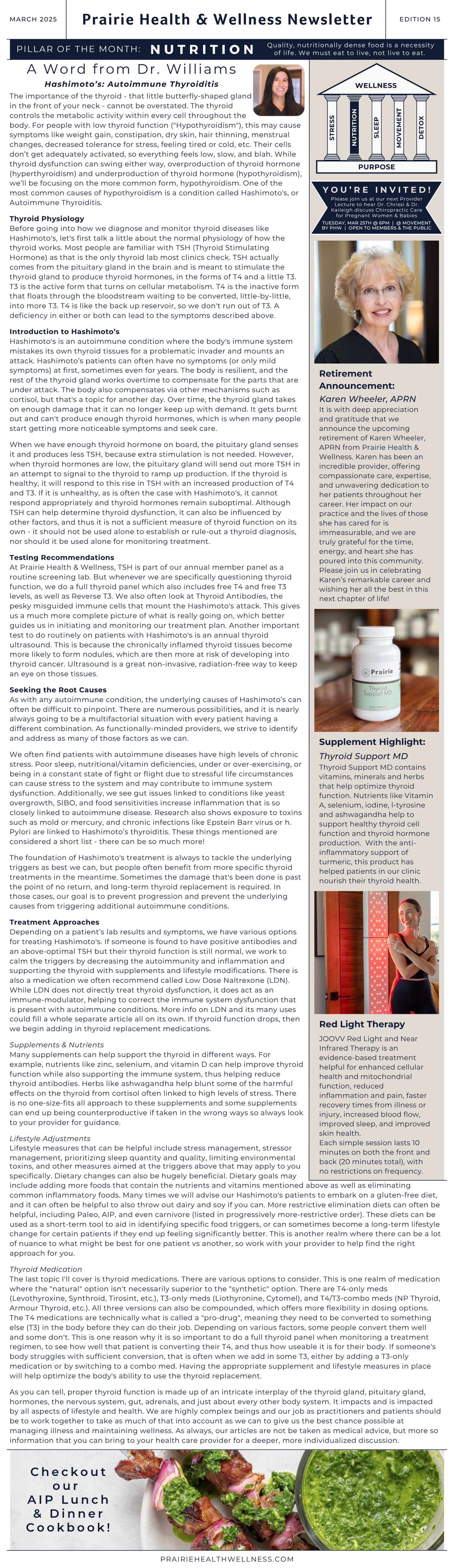
Prairie Health & Wellness Newsletter — March 2025, Edition 15
Pillar of the Month: Nutrition
Quality, nutritionally dense food is a necessity of life. We must eat to live, not live to eat.
A Word from Dr. Williams
Hashimoto's: Autoimmune Thyroiditis
The importance of the thyroid - that little butterfly-shaped gland in the front of your neck - cannot be overstated. The thyroid controls the metabolic activity within every cell throughout the body. For people with low thyroid function ("Hypothyroidism"), this may cause symptoms like weight gain, constipation, dry skin, hair thinning, menstrual changes, decreased tolerance for stress, feeling tired or cold, etc. Their cells don't get adequately activated, so everything feels low, slow, and blah. While thyroid dysfunction can swing either way, overproduction of thyroid hormone (hyperthyroidism) and underproduction of thyroid hormone (hypothyroidism), we'll be focusing on the more common form, hypothyroidism. One of the most common causes of hypothyroidism is a condition called Hashimoto's, or Autoimmune Thyroiditis.
Thyroid Physiology
Before going into how we diagnose and monitor thyroid diseases like Hashimoto's, let's first talk a little about the normal physiology of how the thyroid works. Most people are familiar with TSH (Thyroid Stimulating Hormone) as that is the only thyroid lab most clinics check. TSH actually comes from the pituitary gland in the brain and is meant to stimulate the thyroid gland to produce thyroid hormones, in the forms of T4 and a little T3. T3 is the active form that turns on cellular metabolism. T4 is the inactive form that floats through the bloodstream waiting to be converted, little-by-little, into more T3. T4 is like the back up reservoir, so we don't run out of T3. A deficiency in either or both can lead to the symptoms described above.
Introduction to Hashimoto's
Hashimoto's is an autoimmune condition where the body's immune system mistakes its own thyroid tissues for a problematic invader and mounts an attack. Hashimoto's patients can often have no symptoms (or only mild symptoms) at first, sometimes even for years. The body is resilient, and the rest of the thyroid gland works overtime to compensate for the parts that are under attack. The body also compensates via other mechanisms such as cortisol, but that's a topic for another day. Over time, the thyroid gland takes on enough damage that it can no longer keep up with demand. It gets burnt out and can't produce enough thyroid hormones, which is when many people start getting more noticeable symptoms and seek care.
When we have enough thyroid hormone on board, the pituitary gland senses it and produces less TSH, because extra stimulation is not needed. However, when thyroid hormones are low, the pituitary gland will send out more TSH in an attempt to signal to the thyroid to ramp up production. If the thyroid is healthy, it will respond to this rise in TSH with an increased production of T4 and T3. If it is unhealthy, as is often the case with Hashimoto's, it cannot respond appropriately and thyroid hormones remain suboptimal. Although TSH can help determine thyroid dysfunction, it can also be influenced by other factors, and thus it is not a sufficient measure of thyroid function on its own - it should not be used alone to establish or rule-out a thyroid diagnosis, nor should it be used alone for monitoring treatment.
Testing Recommendations
At Prairie Health & Wellness, TSH is part of our annual member panel as a routine screening lab. But whenever we are specifically questioning thyroid function, we do a full thyroid panel which also includes free T4 and free T3 levels, as well as Reverse T3. We also often look at Thyroid Antibodies, the pesky misguided immune cells that mount the Hashimoto's attack. This gives us a much more complete picture of what is really going on, which better guides us in initiating and monitoring our treatment plan. Another important test to do routinely on patients with Hashimoto's is an annual thyroid ultrasound. This is because the chronically inflamed thyroid tissues become more likely to form nodules, which are then more at risk of developing into thyroid cancer. Ultrasound is a great non-invasive, radiation-free way to keep an eye on those tissues.
Seeking the Root Causes
As with any autoimmune condition, the underlying causes of Hashimoto's can often be difficult to pinpoint. There are numerous possibilities, and it is nearly always going to be a multifactorial situation with every patient having a different combination. As functionally-minded providers, we strive to identify and address as many of those factors as we can.
We often find patients with autoimmune diseases have high levels of chronic stress. Poor sleep, nutritional/vitamin deficiencies, under or over-exercising, or being in a constant state of fight or flight due to stressful life circumstances can cause stress to the system and may contribute to immune system dysfunction. Additionally, we see gut issues linked to conditions like yeast overgrowth, SIBO, and food sensitivities increase inflammation that is so closely linked to autoimmune disease. Research also shows exposure to toxins such as mold or mercury, and chronic infections like Epstein Barr virus or h. Pylori are linked to Hashimoto's thyroiditis. These things mentioned are considered a short list - there can be so much more!
The foundation of Hashimoto's treatment is always to tackle the underlying triggers as best we can, but people often benefit from more specific thyroid treatments in the meantime. Sometimes the damage that's been done is past the point of no return, and long-term thyroid replacement is required. In those cases, our goal is to prevent progression and prevent the underlying causes from triggering additional autoimmune conditions.
Treatment Approaches
Depending on a patient's lab results and symptoms, we have various options for treating Hashimoto's. If someone is found to have positive antibodies and an above-optimal TSH but their thyroid function is still normal, we work to calm the triggers by decreasing the autoimmunity and inflammation and supporting the thyroid with supplements and lifestyle modifications. There is also a medication we often recommend called Low Dose Naltrexone (LDN). While LDN does not directly treat thyroid dysfunction, it does act as an immune-modulator, helping to correct the immune system dysfunction that is present with autoimmune conditions. More info on LDN and its many uses could fill a whole separate article all on its own. If thyroid function drops, then we begin adding in thyroid replacement medications.
Supplements & Nutrients
Many supplements can help support the thyroid in different ways. For example, nutrients like zinc, selenium, and vitamin D can help improve thyroid function while also supporting the immune system, thus helping reduce thyroid antibodies. Herbs like ashwagandha help blunt some of the harmful effects on the thyroid from cortisol often linked to high levels of stress. There is no one-size-fits all approach to these supplements and some supplements can end up being counterproductive if taken in the wrong ways so always look to your provider for guidance.
Lifestyle Adjustments
Lifestyle measures that can be helpful include stress management, stressor management, prioritizing sleep quantity and quality, limiting environmental toxins, and other measures aimed at the triggers above that may apply to you specifically. Dietary changes can also be hugely beneficial. Dietary goals may include adding more foods that contain the nutrients and vitamins mentioned above as well as eliminating common inflammatory foods. Many times we will advise our Hashimoto's patients to embark on a gluten-free diet, and it can often be helpful to also throw out dairy and soy if you can. More restrictive elimination diets can often be helpful, including Paleo, AIP, and even carnivore (listed in progressively more-restrictive order). These diets can be used as a short-term tool to aid in identifying specific food triggers, or can sometimes become a long-term lifestyle change for certain patients if they end up feeling significantly better. This is another realm where there can be a lot of nuance to what might be best for one patient vs another, so work with your provider to help find the right approach for you.
Thyroid Medication
The last topic I'll cover is thyroid medications. There are various options to consider. This is one realm of medication where the "natural" option isn't necessarily superior to the "synthetic" option. There are T4-only meds (Levothyroxine, Synthroid, Tirosint, etc.), T3-only meds (Liothyronine, Cytomel), and T4/T3-combo meds (NP Thyroid, Armour Thyroid, etc.). All three versions can also be compounded, which offers more flexibility in dosing options. The T4 medications are technically what is called a "pro-drug", meaning they need to be converted to something else (T3) in the body before they can do their job. Depending on various factors, some people convert them well and some don't. This is one reason why it is so important to do a full thyroid panel when monitoring a treatment regimen, to see how well that patient is converting their T4, and thus how useable it is for their body. If someone's body struggles with sufficient conversion, that is often when we add in some T3, either by adding a T3-only medication or by switching to a combo med. Having the appropriate supplement and lifestyle measures in place will help optimize the body's ability to use the thyroid replacement.
As you can tell, proper thyroid function is made up of an intricate interplay of the thyroid gland, pituitary gland, hormones, the nervous system, gut, adrenals, and just about every other body system. It impacts and is impacted by all aspects of lifestyle and health. We are highly complex beings and our job as practitioners and patients should be to work together to take as much of that into account as we can to give us the best chance possible at managing illness and maintaining wellness. As always, our articles are not be taken as medical advice, but more so information that you can bring to your health care provider for a deeper, more individualized discussion.
You're Invited!
Please join us at our next Provider Lecture to hear Dr. Chrissi & Dr. Kaileigh discuss Chiropractic Care for Pregnant Women & Babies
TUESDAY, MAR 25TH @ 6PM | @ MOVEMENT BY PHW | OPEN TO MEMBERS & THE PUBLIC
Retirement Announcement: Karen Wheeler, APRN
It is with deep appreciation and gratitude that we announce the upcoming retirement of Karen Wheeler, APRN from Prairie Health & Wellness. Karen has been an incredible provider, offering compassionate care, expertise, and unwavering dedication to her patients throughout her career. Her impact on our practice and the lives of those she has cared for is immeasurable, and we are truly grateful for the time, energy, and heart she has poured into this community. Please join us in celebrating Karen's remarkable career and wishing her all the best in this next chapter of life!
Supplement Highlight: Thyroid Support MD
Thyroid Support MD contains vitamins, minerals and herbs that help optimize thyroid function. Nutrients like Vitamin A, selenium, iodine, l-tyrosine and ashwagandha help to support healthy thyroid cell function and thyroid hormone production. With the anti-inflammatory support of turmeric, this product has helped patients in our clinic nourish their thyroid health.
Red Light Therapy
JOOVV Red Light and Near Infrared Therapy is an evidence-based treatment helpful for enhanced cellular health and mitochondrial function, reduced inflammation and pain, faster recovery times from illness or injury, increased blood flow, improved sleep, and improved skin health.
Each simple session lasts 10 minutes on both the front and back (20 minutes total), with no restrictions on frequency.
Checkout our AIP Lunch & Dinner Cookbook!
PRAIRIEHEALTHWELLNESS.COM