
Prairie Health & Wellness Newsletter — January 2025, Edition 13
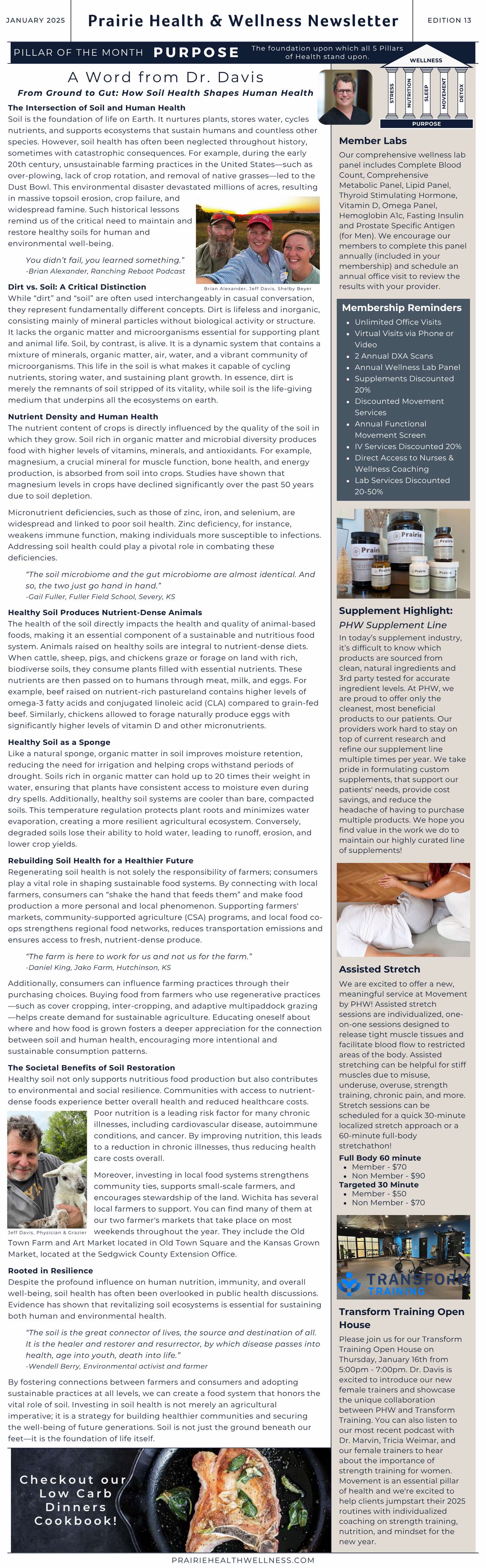
Pillar of the Month: Purpose
The foundation upon which all 5 Pillars of Health stand upon.
A Word from Dr. Davis
From Ground to Gut: How Soil Health Shapes Human Health
The Intersection of Soil and Human Health
Soil is the foundation of life on Earth. It nurtures plants, stores water, cycles nutrients, and supports ecosystems that sustain humans and countless other species. However, soil health has often been neglected throughout history, sometimes with catastrophic consequences. For example, during the early 20th century, unsustainable farming practices in the United States—such as over-plowing, lack of crop rotation, and removal of native grasses—led to the Dust Bowl. This environmental disaster devastated millions of acres, resulting in massive topsoil erosion, crop failure, and widespread famine. Such historical lessons remind us of the critical need to maintain and restore healthy soils for human and environmental well-being.
You didn't fail, you learned something.” -Brian Alexander, Ranching Reboot Podcast
Brian Alexander, Jeff Davis, Shelby Beyer
Dirt vs. Soil: A Critical Distinction
While “dirt” and “soil” are often used interchangeably in casual conversation, they represent fundamentally different concepts. Dirt is lifeless and inorganic, consisting mainly of mineral particles without biological activity or structure. It lacks the organic matter and microorganisms essential for supporting plant and animal life. Soil, by contrast, is alive. It is a dynamic system that contains a mixture of minerals, organic matter, air, water, and a vibrant community of microorganisms. This life in the soil is what makes it capable of cycling nutrients, storing water, and sustaining plant growth. In essence, dirt is merely the remnants of soil stripped of its vitality, while soil is the life-giving medium that underpins all the ecosystems on earth.
Nutrient Density and Human Health
The nutrient content of crops is directly influenced by the quality of the soil in which they grow. Soil rich in organic matter and microbial diversity produces food with higher levels of vitamins, minerals, and antioxidants. For example, magnesium, a crucial mineral for muscle function, bone health, and energy production, is absorbed from soil into crops. Studies have shown that magnesium levels in crops have declined significantly over the past 50 years due to soil depletion.
Micronutrient deficiencies, such as those of zinc, iron, and selenium, are widespread and linked to poor soil health. Zinc deficiency, for instance, weakens immune function, making individuals more susceptible to infections. Addressing soil health could play a pivotal role in combating these deficiencies.
“The soil microbiome and the gut microbiome are almost identical. And so, the two just go hand in hand.” -Gail Fuller, Fuller Field School, Severy, KS
Healthy Soil Produces Nutrient-Dense Animals
The health of the soil directly impacts the health and quality of animal-based foods, making it an essential component of a sustainable and nutritious food system. Animals raised on healthy soils are integral to nutrient-dense diets. When cattle, sheep, pigs, and chickens graze or forage on land with rich, biodiverse soils, they consume plants filled with essential nutrients. These nutrients are then passed on to humans through meat, milk, and eggs. For example, beef raised on nutrient-rich pastureland contains higher levels of omega-3 fatty acids and conjugated linoleic acid (CLA) compared to grain-fed beef. Similarly, chickens allowed to forage naturally produce eggs with significantly higher levels of vitamin D and other micronutrients.
Healthy Soil as a Sponge
Like a natural sponge, organic matter in soil improves moisture retention, reducing the need for irrigation and helping crops withstand periods of drought. Soils rich in organic matter can hold up to 20 times their weight in water, ensuring that plants have consistent access to moisture even during dry spells. Additionally, healthy soil systems are cooler than bare, compacted soils. This temperature regulation protects plant roots and minimizes water evaporation, creating a more resilient agricultural ecosystem. Conversely, degraded soils lose their ability to hold water, leading to runoff, erosion, and lower crop yields.
Rebuilding Soil Health for a Healthier Future
Regenerating soil health is not solely the responsibility of farmers; consumers play a vital role in shaping sustainable food systems. By connecting with local farmers, consumers can “shake the hand that feeds them” and make food production a more personal and local phenomenon. Supporting farmers' markets, community-supported agriculture (CSA) programs, and local food co-ops strengthens regional food networks, reduces transportation emissions and ensures access to fresh, nutrient-dense produce.
“The farm is here to work for us and not us for the farm.” -Daniel King, Jako Farm, Hutchinson, KS
Additionally, consumers can influence farming practices through their purchasing choices. Buying food from farmers who use regenerative practices—such as cover cropping, inter-cropping, and adaptive multipaddock grazing—helps create demand for sustainable agriculture. Educating oneself about where and how food is grown fosters a deeper appreciation for the connection between soil and human health, encouraging more intentional and sustainable consumption patterns.
The Societal Benefits of Soil Restoration
Healthy soil not only supports nutritious food production but also contributes to environmental and social resilience. Communities with access to nutrient-dense foods experience better overall health and reduced healthcare costs.
Poor nutrition is a leading risk factor for many chronic illnesses, including cardiovascular disease, autoimmune conditions, and cancer. By improving nutrition, this leads to a reduction in chronic illnesses, thus reducing health care costs overall.
Moreover, investing in local food systems strengthens community ties, supports small-scale farmers, and encourages stewardship of the land. Wichita has several local farmers to support. You can find many of them at our two farmer's markets that take place on most weekends throughout the year. They include the Old Town Farm and Art Market located in Old Town Square and the Kansas Grown Market, located at the Sedgwick County Extension Office.
Jeff Davis, Physician & Grazier
Rooted in Resilience
Despite the profound influence on human nutrition, immunity, and overall well-being, soil health has often been overlooked in public health discussions. Evidence has shown that revitalizing soil ecosystems is essential for sustaining both human and environmental health.
“The soil is the great connector of lives, the source and destination of all. It is the healer and restorer and resurrector, by which disease passes into health, age into youth, death into life.” -Wendell Berry, Environmental activist and farmer
By fostering connections between farmers and consumers and adopting sustainable practices at all levels, we can create a food system that honors the vital role of soil. Investing in soil health is not merely an agricultural imperative; it is a strategy for building healthier communities and securing the well-being of future generations. Soil is not just the ground beneath our feet—it is the foundation of life itself.
Member Labs
Our comprehensive wellness lab panel includes Complete Blood Count, Comprehensive Metabolic Panel, Lipid Panel, Thyroid Stimulating Hormone, Vitamin D, Omega Panel, Hemoglobin A1c, Fasting Insulin and Prostate Specific Antigen (for Men). We encourage our members to complete this panel annually (included in your membership) and schedule an annual office visit to review the results with your provider.
Membership Reminders
- Unlimited Office Visits
- Virtual Visits via Phone or Video
- 2 Annual DXA Scans
- Annual Wellness Lab Panel
- Supplements Discounted 20%
- Discounted Movement Services
- Annual Functional Movement Screen
- IV Services Discounted 20%
- Direct Access to Nurses & Wellness Coaching
- Lab Services Discounted 20-50%
Supplement Highlight: PHW Supplement Line
In today’s supplement industry, it’s difficult to know which products are sourced from clean, natural ingredients and 3rd party tested for accurate ingredient levels. At PHW, we are proud to offer only the cleanest, most beneficial products to our patients. Our providers work hard to stay on top of current research and refine our supplement line multiple times per year. We take pride in formulating custom supplements, that support our patients' needs, provide cost savings, and reduce the headache of having to purchase multiple products. We hope you find value in the work we do to maintain our highly curated line of supplements!
Assisted Stretch
We are excited to offer a new, meaningful service at Movement by PHW! Assisted stretch sessions are individualized, one-on-one sessions designed to release tight muscle tissues and facilitate blood flow to restricted areas of the body. Assisted stretching can be helpful for stiff muscles due to misuse, underuse, overuse, strength training, chronic pain, and more. Stretch sessions can be scheduled for a quick 30-minute localized stretch approach or a 60-minute full-body stretchathon!
Full Body 60 minute
- Member - $70
- Non Member - $90
Targeted 30 Minute
- Member - $50
- Non Member - $70
Transform Training Open House
Please join us for our Transform Training Open House on Thursday, January 16th from 5:00pm - 7:00pm. Dr. Davis is excited to introduce our new female trainers and showcase the unique collaboration between PHW and Transform Training. You can also listen to our most recent podcast with Dr. Marvin, Tricia Weimar, and our female trainers to hear about the importance of strength training for women. Movement is an essential pillar of health and we're excited to help clients jumpstart their 2025 routines with individualized coaching on strength training, nutrition, and mindset for the new year.
Checkout our Low Carb Dinners Cookbook!
PRAIRIEHEALTHWELLNESS.COM